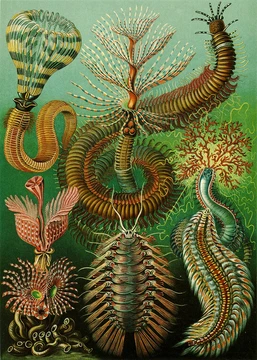
Shipworm
Marine bivalves that bore into and consume submerged wood.

Shipworms, also known as teredo worms or simply teredo, are a group of xylophagic marine bivalve molluscs in the family Teredinidae that consume wood submerged in saltwater. Their elongated, vermiform appearance makes their classification as bivalves not obvious, and sailors generally refer to them as 'worms,' though taxonomically they are more akin to clams. Shipworms are notorious for boring into and eventually destroying any wooden structure immersed in seawater, including piers, docks, and ships, earning them the nickname 'termites of the sea.'
- field
- Marine bivalve molluscs (family Teredinidae)
- known_for
- Boring into and destroying submerged wooden structures; xylophagic behavior
- notable_species
- Teredo navalis (best known), Kuphus polythalamia (up to 1.6 m long), Lithoredo abatanica (burrows limestone)
- lifespan
- 1 to 3 years
- average_size
- 10 to 15 cm in length, less than 6 mm in diameter
Lore & Background
Shipworms are marine animals in the phylum Mollusca, class Bivalvia, family Teredinidae. The body is cylindrical, slender, naked, and superficially worm-shaped, but shipworms still possess recognisable bivalve morphology, including valves, ctinidia, a mantle, and siphons. The two valves of the main shell are at the anterior end and are used for boring into wood, while the siphons protrude from the posterior end and can be withdrawn behind calcareous pallets for protection. Shipworms develop from eggs to metamorphosing larvae in about five weeks, spending half of that time in the mother's gill chamber before being discharged as free-swimming larvae. Their sexes alternate: young are hermaphrodites, while adults can be either male or female, typically male first and female subsequently. They have a lifespan of 1 to 3 years. When shipworms bore into submerged wood, bacterial symbionts in the typhlosole (a sub-organ in the gut) aid digestion of wood particles, with Alteromonas bacteria digesting lignin. Another bacterial species, Teredinibacter turnerae, in the gills secretes cellulose-digesting enzymes that may enter the gut via the gland of Deshayes.
Reader's Guide
Shipworms are significant primarily as destructive agents of wooden maritime structures, including ships, piers, and docks, causing substantial economic and historical damage. Their ability to digest wood through symbiotic bacteria has also made them a subject of scientific interest, particularly for research into bioconversion of cellulose for fuel energy. The family Teredinidae includes several genera, with Teredo being the most commonly mentioned and Teredo navalis the best-known species. Historically, shipworm concentrations in the Caribbean Sea have been substantially higher than in most other salt water bodies. The species Kuphus polythalamia is notable as one of the world's largest bivalves, reaching over 1.6 m in length, while Lithoredo abatanica uniquely burrows and feeds on carbonated limestone in fresh water. The study of shipworm endosymbionts continues to inform research on biofuel production.
Did You Know?
- Shipworms are taxonomically bivalves, more akin to clams, despite their worm-like appearance.
- One species, Kuphus polythalamia, can reach over 1.6 m in length and 7 cm in diameter, making it one of the world's largest bivalves.
- Another species, Lithoredo abatanica, burrows and feeds on carbonated limestone and lives in fresh water.
- Shipworms have a lifespan of 1 to 3 years and their sexes alternate: young are hermaphrodites, while adults can be male or female.
More in Marine Invertebrates 1-24
Elsewhere in the Marine Invertebrates universe
Spotted an error? Know more?
This is a living reference — every entry is fact-audited, and reader corrections feed straight into our audit queue. Suggest an edit · See this site's audit record