Sunflower sea star

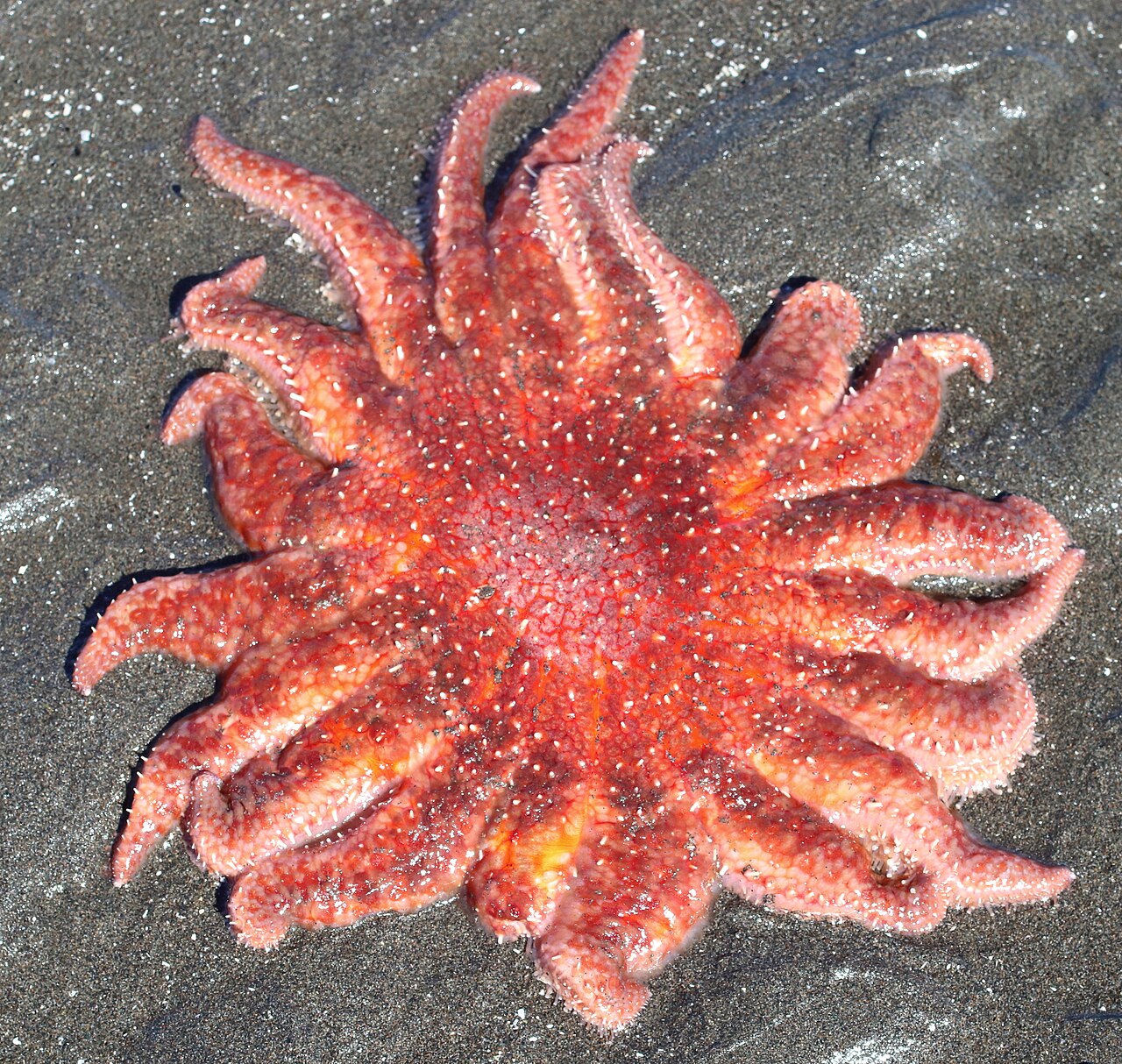
(c) Erin McKittrick, some rights reserved (CC BY) · CC BY 4.0
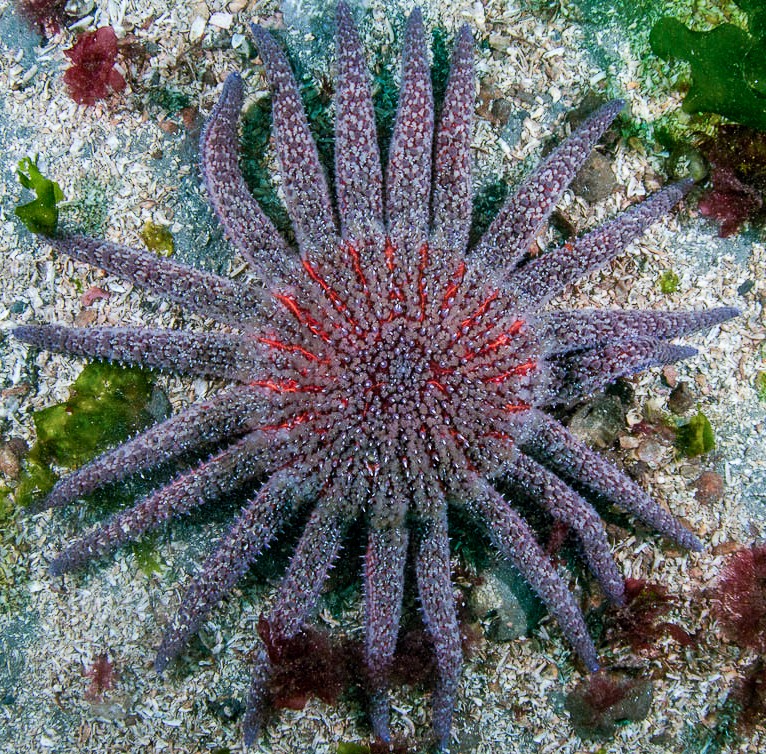
The sunflower sea star (Pycnopodia helianthoides) is a large sea star found in the northeastern Pacific Ocean. The only species of its genus, it is among the largest sea stars in the world, with a maximum arm span of 1.5 meters.
- Maximum arm span
- 1.5 m (4.9 ft)
- Typical number of limbs
- 15–24
- Lifespan
- 3–5 years (up to 10+ years in the wild)
- Primary threat
- Sea star wasting disease (associated with a densovirus, SSaDV, and other factors)
Lore & Background
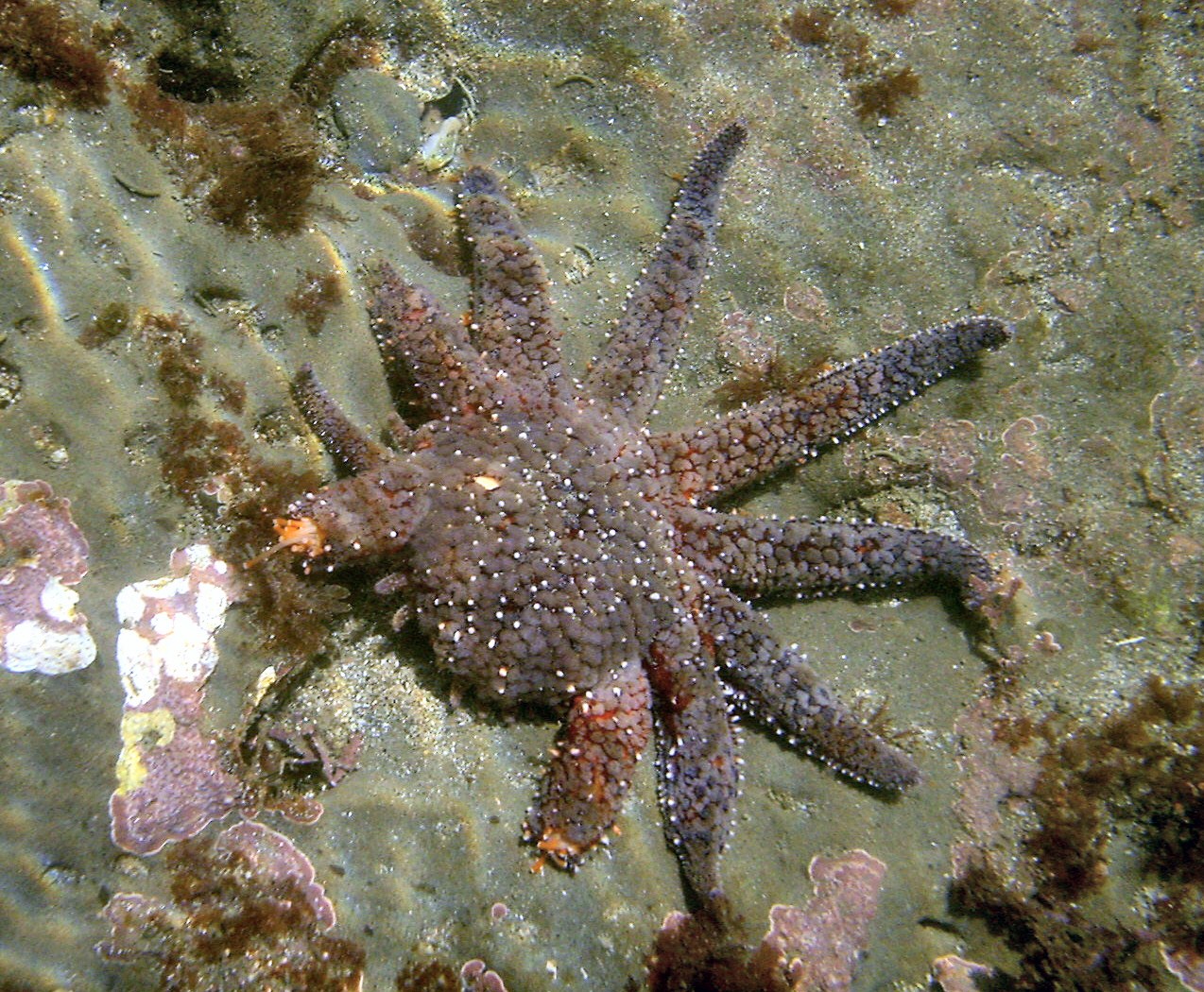
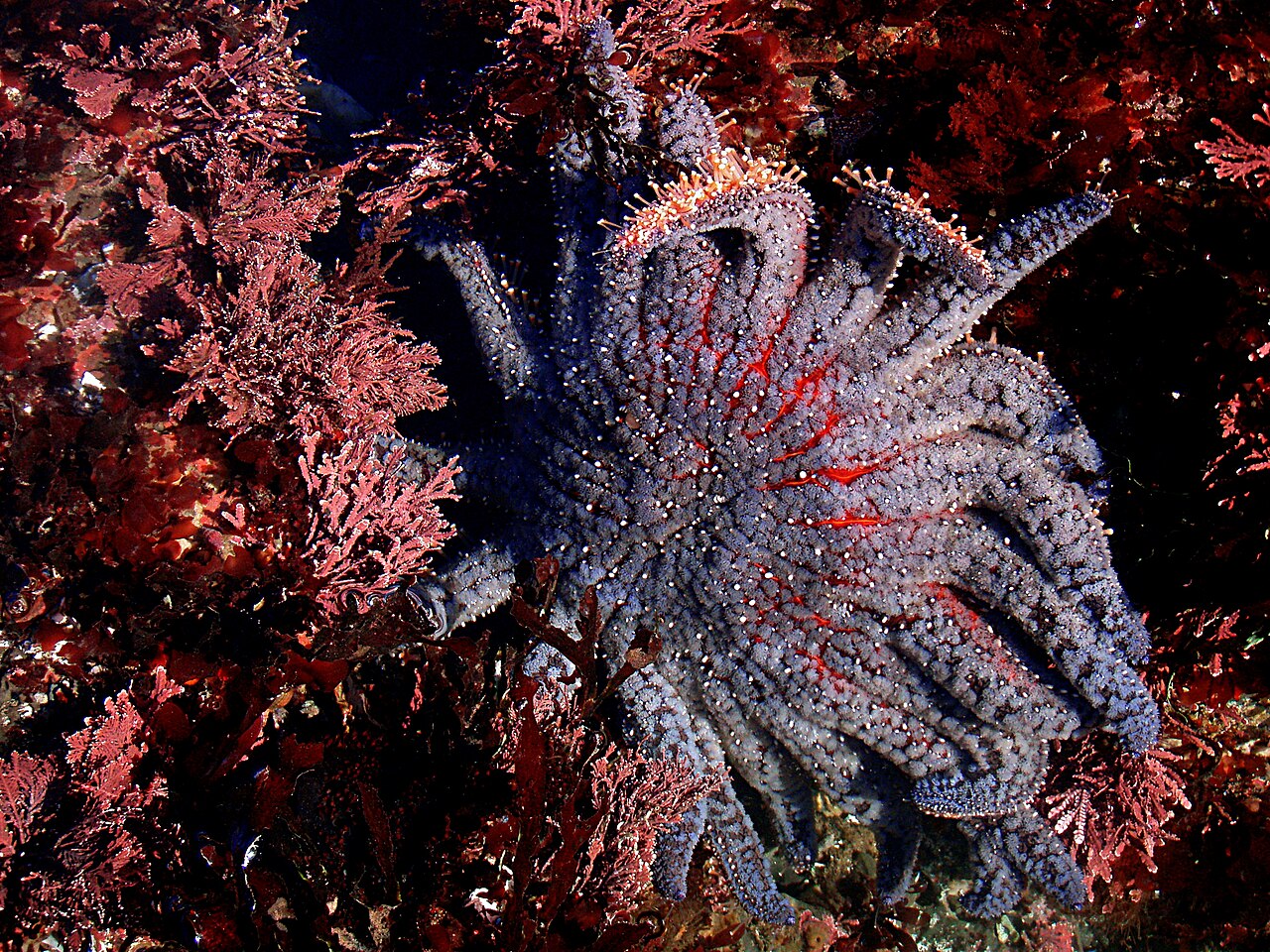
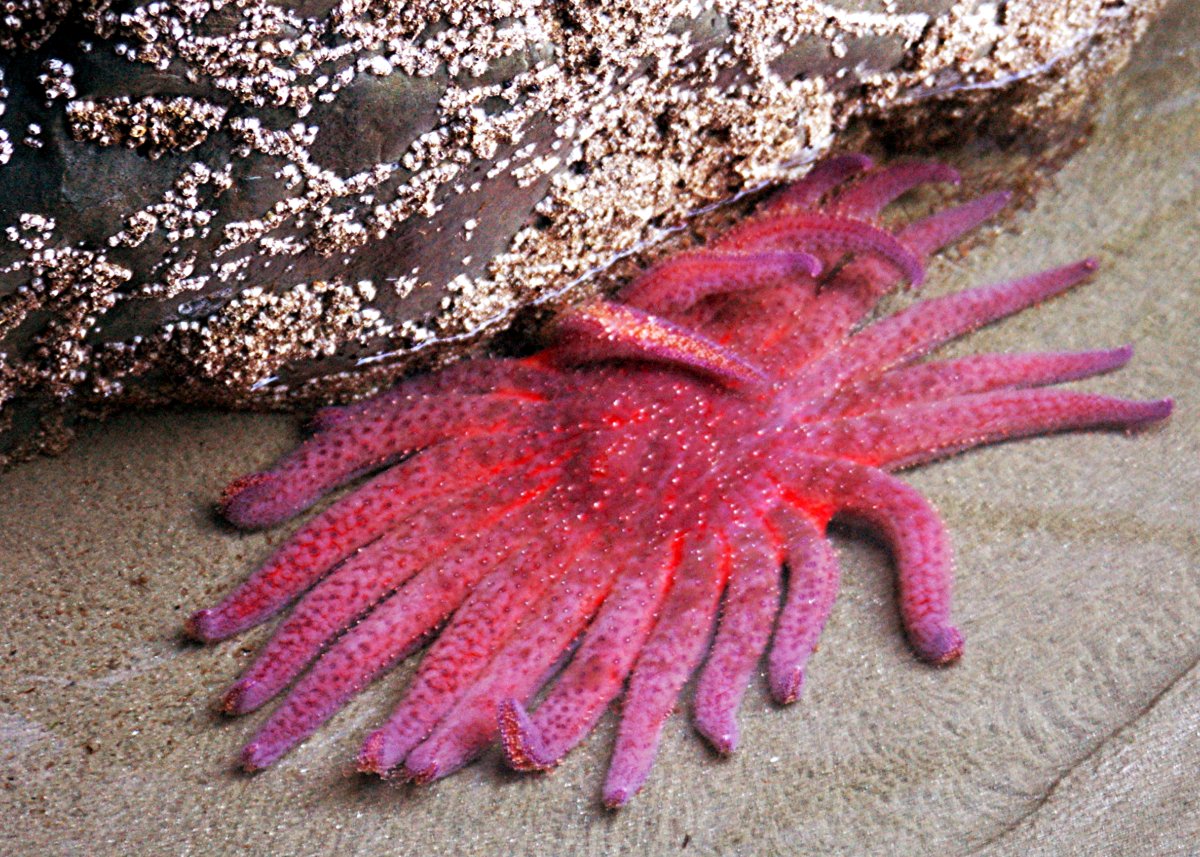
Sunflower sea stars were once common in the northeast Pacific from Alaska to southern California, dominating areas such as Puget Sound, British Columbia, northern California, and southern Alaska. Their color ranges from bright orange, yellow-red to brown, and sometimes purple, with soft, velvet-textured bodies and 15–24 arms (juveniles start with 5) with powerful suckers. They feed mostly on sea urchins, clams, sea snails, and other small invertebrates, but also eat mussels, abalone, crustaceans, fish, sea cucumbers, sand dollars, other sea stars, and occasionally algae and sponges. They can extend their stomach outside the mouth to digest prey. Easily stressed by predators such as large fish and other sea stars, they can shed arms to escape, which regrow within a few weeks. Sunflower sea stars reproduce sexually through broadcast spawning, with separate sexes breeding from May through June. Larvae float near the surface for two to ten weeks before settling to the bottom and maturing into juveniles, which begin with five arms and grow the rest as they age.
Reader's Guide
The sunflower sea star is significant as a keystone predator in northeastern Pacific kelp forest ecosystems. Its primary prey includes sea urchins, and by controlling urchin populations, it helps maintain the health of kelp forests. The species disappeared from waters off California and Oregon. Endangered Species Act. The loss of sunflower sea stars has led to increased sea urchin populations, threatening kelp forest biodiversity. Their decline illustrates the cascading effects of disease and climate change on marine ecosystems.
Did You Know?
- Sunflower sea stars can reach an arm span of up to 1.5 meters, but they are not the heaviest known sea star.
- Sea star wasting disease is associated with a densovirus (SSaDV) and other factors, not a bacterium.
- Juvenile sunflower sea stars begin life with five arms and grow the rest as they mature, with adults typically having 15–24 arms.
Physical Form and Life Cycle
Physically, Pycnopodia helianthoides stands apart among echinoderms as the heaviest known sea star, tipping the scales at roughly five kilograms, and as the second-largest in the world, trailing only the obscure deep-water species Midgardia xandaros. Adults typically bear between sixteen and twenty-four limbs, though the range extends from five to twenty-four, and their soft, velvet-textured bodies come in a spectrum of bright orange, yellow-red, brown, and occasionally purple hues. Beneath their undersides, approximately fifteen thousand tube feet equipped with powerful suckers enable locomotion at about one meter per minute. Growth is rapid in early life—around eight centimeters per year for the first several years—before slowing to roughly two and a half centimeters annually. Like most sea stars, they possess a mesh-like internal skeleton shielding their organs. The species has separate sexes and reproduces by broadcast spawning between May and June, with planktonic larvae drifting near the surface for two to ten weeks before settling and maturing into juveniles that begin with just five arms. Most individuals live three to five years.
Hunting Strategy and Ecological Role
As apex invertebrate predators of the northeastern Pacific, sunflower sea stars are relentless hunters, cruising at roughly one meter per minute on their fifteen thousand tube feet. Their diet is overwhelmingly carnivorous, centered on sea urchins, clams, mussels, sea snails, abalone, crabs, barnacles, fish, sea cucumbers, sand dollars, and even other sea stars, with occasional forays into algae and sponges. In Monterey Bay they have been observed scavenging dead or dying squid. Their feeding strategy is remarkably flexible: the stomach can evert outside the body to envelop larger prey such as abalone, and appetite shifts with local climate, prey abundance, and latitude. They are most frequently encountered around urchin barrens, reflecting their strong preference for urchins. When threatened by large fish or rival sea stars, they can autotomize an arm and regrow it within weeks, though the king crab remains a persistent natural predator. Ecologically, their role as a primary sea urchin predator is critical; by suppressing urchin numbers they help sustain the structural integrity and biodiversity of kelp forests throughout their former range.
The Collapse: Disease and Warming Waters
For decades, sunflower sea stars dominated rocky and sandy seafloors from southern Alaska down to southern California, thriving in low subtidal and intertidal zones rich in kelp, shells, gravel, and mud, and tolerating depths to four hundred thirty-five meters. Their heavy bodies, however, prevent them from surviving in high or mid-tide zones where water cannot support their weight. A wasting disease—characterized by behavioral changes, tissue lesions, progressive limb loss, and eventual death from whole-body degradation—combined with anomalously warm water linked to global climate change to trigger a catastrophic collapse. The species vanished entirely from California and Oregon coastal waters, and populations near Washington dropped by ninety-nine point two percent.
Conservation and the Road to Recovery
The Nature Conservancy, together with partner organizations and the University of Washington, has launched captive breeding programs that encompass seasonal spawning trials, larval development studies, and experiments on juvenile growth and feeding success—essentially attempting to rebuild a population in a controlled setting before reintroducing individuals to the wild. Endangered Species Act. The urgency extends beyond the species itself: with its primary urchin predator gone, unchecked urchin populations are degrading kelp forests and eroding marine biodiversity across the northeastern Pacific, making the sea star's recovery a linchpin for the health of entire coastal ecosystems.
Gallery
More in Marine Invertebrates 25-30
Elsewhere in the Marine Invertebrates universe
Spotted an error? Know more?
This is a living reference — every entry is fact-audited, and reader corrections feed straight into our audit queue. Suggest an edit · See this site's audit record