Vampire squid
A deep-sea cephalopod that thrives in oxygen-poor waters.
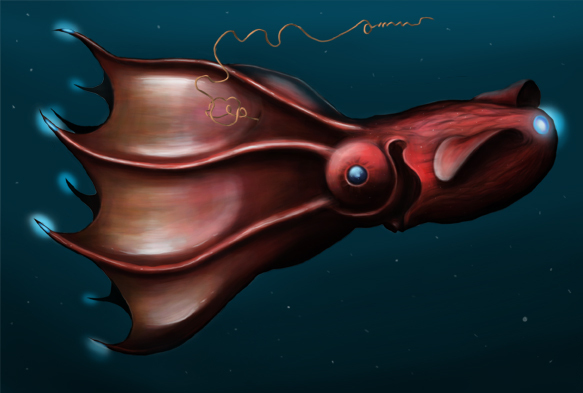
The vampire squid (*Vampyroteuthis infernalis*, meaning "vampire squid from hell") is a small cephalopod that lives in the deep, oxygen-poor waters of temperate and tropical oceans. It is a living fossil—the only surviving species in the order Vampyromorphida—and is more closely related to octopuses than to true squids. Its most distinctive feature is a pair of long, retractable filaments on its back, located between the first two pairs of arms. These filaments, along with its bioluminescent organs and a specialized oxygen metabolism, allow it to survive in areas with the lowest oxygen levels in the ocean.
The first vampire squid specimens were collected during the Valdivia Expedition (1898–1899), led by German zoologist Carl Chun. Chun originally described the animal as an octopus in 1903, but it was later reclassified into its own order, Vampyromorphida, alongside several extinct species. The expedition was funded by a German scientific society that wanted to prove life existed below 550 meters, challenging the then-popular Abyssus theory. The ship *Valdivia* was equipped with labs and collection gear, and the voyage traced the west coast of Africa, then around the southern tip of the continent into the Indian and Antarctic Oceans. No fossils of this family had been found from the Cenozoic era, which suggests either a preservation bias (the Lazarus effect) or a mistaken timeline for when vampire squids first colonized the deep sea.
In 2024, a second species, *Vampyroteuthis pseudoinfernalis*, was proposed based on differences in beak shape, mantle form, and genetics. However, a 2026 re-examination found no consistent morphological or genetic differences, and the new species is now considered a junior synonym of *V. infernalis*.
The vampire squid reaches about 30 cm (1 ft) in total length, with a gelatinous body ranging from jet-black to pale reddish. A webbing of skin connects its eight arms, each lined with rows of fleshy spines (cirri); only the outer halves of the arms have suckers. Its large, globular eyes—proportionally the biggest in the animal kingdom—can appear red or blue depending on lighting, and are matched by enlarged optic lobes in the brain. Mature adults have a pair of small, earlike fins on the sides of the mantle, which they flap to move. Inside the webbing are two pouches hiding the tactile velar filaments, which are similar to squid tentacles but differ in origin. The vampire squid is covered with photophores (light-producing organs) that can flash for fractions of a second to several minutes. Two white spots on the head were once thought to be photophores but are actually photoreceptors. Its chromatophores are poorly developed, so it cannot change color like shallow-water cephalopods—a useless ability in the dark depths.
Phylogenetically, the Vampyromorphida is the sister group to all octopuses, having diverged first among the Octopodiformes. The group is defined by shared features such as photophores, two velar filaments (modified arms), an internal gladius (like squids), and eight webbed arms with cirri (like cirrate octopuses).
- field
- Marine biology, teuthology
- known_for
- Only surviving member of order Vampyromorphida; thrives in oxygen minimum zones
- maximum_length
- ~30 cm (1 ft)
Lore & Background
The voyage began in Hamburg, traced around the west coast of Africa, and studied deep areas of the Indian and Antarctic Ocean. The vampire squid's genus name comes from Latin vampyrus and Ancient Greek teuthís, meaning 'vampire squid,' and its species name infernalis means 'of hell.' The name was inspired by its dark color and cloaklike webbing, not its feeding habits—it feeds on detritus, not blood. Its gelatinous body reaches about 30 cm, with eight webbed arms lined with cirri, and its eyes are proportionately the largest of any cephalopod. It is almost entirely covered in photophores that produce disorienting flashes of light, and it has poorly developed chromatophores, so it can change color to some degree, though not as dramatically as shallow-dwelling cephalopods. The vampire squid is the only cephalopod able to live its entire life cycle in the oxygen minimum zone, at oxygen saturations as low as 3%. Its low metabolic rate, efficient hemocyanin, and ammonium-rich tissues help it survive, and its large eyes are adapted for sensing distant bioluminescence.
Reader's Guide
The vampire squid holds significant scientific importance as a phylogenetic relict, representing the only surviving member of the order Vampyromorphida. Its unique adaptations to the oxygen minimum zone—including the lowest mass-specific metabolic rate among deep-sea cephalopods, highly efficient oxygen-binding hemocyanin, and gills with large surface area—make it a key subject for studying extreme deep-sea survival. The vampire squid's bioluminescent photophores, largest eyes in the animal kingdom relative to body size, and use of retractile filaments distinguish it from both octopuses and squids. Its presence in the fossil record suggests a possible Lazarus effect, with scarce post-Cretaceous remains complicating understanding of its evolutionary history. As an extreme example of deep-sea specialization, it provides insights into metabolic and sensory adaptations in one of Earth's most challenging habitats.
Did You Know?
- The vampire squid is the only known surviving member of the order Vampyromorphida.
- Its eyes are proportionately the largest of any cephalopod, with a 15 cm squid having eyes 2.5 cm in diameter.
- It can survive in oxygen saturations as low as 3%, the only cephalopod able to live its entire life cycle in the oxygen minimum zone.
Position in the Cephalopod Spectrum
The vampire squid occupies a fascinating niche within the vast size spectrum of cephalopods. This group of marine invertebrates spans an extraordinary range: the tiniest species reach maturity at barely a centimetre in length and weigh under a gram, while the giant squid stretches beyond ten metres and the colossal squid tips the scales at nearly five hundred kilograms. Across all living cephalopods, mass varies by more than three billion times, spanning nine full orders of magnitude from the lightest hatchlings to the heaviest adults. The vampire squid, as a member of the vampyromorphid lineage, sits within this remarkable continuum. Some cephalopod species are also distinguished by individual body parts of exceptional proportions, reminding us that overall size tells only part of the story. Understanding where the vampire squid falls in this spectrum helps researchers contextualise its biology, ecology, and evolutionary pressures against both its tiny relatives and its colossal cousins.
Echoes from the Fossil Record
Long before modern cephalopods dominated the oceans, their ancient relatives ruled the seas as the largest organisms on Earth. The fossil record preserves numerous species comparable in size to today's biggest squids, including enormous ammonoids, belemnoids, nautiloids, orthoceratoids, teuthids, and vampyromorphids. The vampire squid's own lineage, the vampyromorphids, is explicitly represented among these prehistoric giants, linking the modern creature to a deep evolutionary heritage of large-bodied cephalopods. In terms of sheer mass, the largest known cephalopods of all time were likely the giant shelled ammonoids and endocerid nautiloids, though when considering tissue mass alone, some of these ancient forms may still rank behind the largest living cephalopods. This paleontological depth underscores that the vampire squid is not an isolated oddity but a living thread connecting to hundreds of millions of years of cephalopod evolution, where size and form have been reshaped repeatedly across geological epochs.
Tentacles in Myth and Legend
The image of an enormous, tentacled creature lurking beneath the waves has haunted human imagination since the earliest written records. Aristotle and Pliny the Elder both described squids of extraordinary size, and mariners have passed down tales of giant squid encounters since ancient times. These real sightings likely seeded the monstrous kraken of Nordic legend, a beast said to be as large as an island and capable of swallowing whole ships. Similar tentacled sea monsters appear across the globe: Akkorokamui in Japanese folklore, Te Wheke-a-Muturangi in Māori tradition, the Lusca of Caribbean waters, and Scylla in Greek mythology. Even accounts of sea serpents may trace back to misidentified giant squid encounters. The vampire squid, with its distinctive webbed arms and deep-sea habitat, belongs to the same cephalopod family that inspired these stories, making it a living echo of the creatures that shaped humanity's oldest fears of the ocean's depths.
The Science of Sizing a Squid
Measuring a vampire squid or any cephalopod is far from straightforward. Mantle length, the standard metric in the scientific literature, is taken as a straight-line dorsal measurement along the midline of the mantle, from the anterior edge near the head to the posterior end or the apex of the united fins, whichever extends further. For eight-limbed species, where head and mantle are more fused, the measurement begins at the midpoint between the eyes. Total length, measured with limbs outstretched along the body axis, is more often cited for the largest species but is prone to exaggeration when tentacles are artificially stretched. A related standard length excludes the long feeding tentacles entirely. Preservation complicates matters further: gelatinous species shrink substantially, and some benthic octopuses can elongate or retract their mantles, making even live measurements variable. The St.
Gallery
More in Marine Invertebrates 1-24
Spotted an error? Know more?
This is a living reference — every entry is fact-audited, and reader corrections feed straight into our audit queue. Suggest an edit · See this site's audit record